



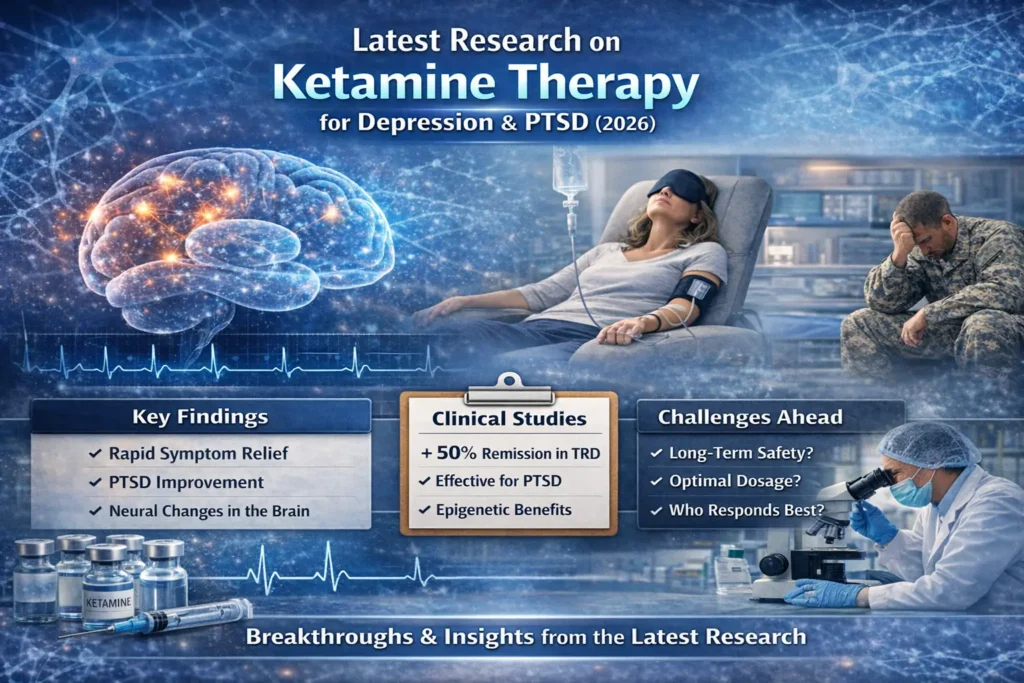
Mental health treatment is undergoing a major transformation, and few innovations have generated as much attention as ketamine therapy. Originally developed as an anesthetic, ketamine is now being widely studied for its rapid antidepressant effects and potential to treat post-traumatic stress disorder (PTSD). As of 2025–2026, emerging research is shedding new light on how ketamine works, who it benefits, and where its limitations lie.
This article explores the latest scientific findings, clinical trials, and real-world data on ketamine therapy for depression and PTSD.
The Growing Need for New Treatments
Depression and PTSD remain two of the most challenging mental health conditions globally. Traditional antidepressants—such as SSRIs—can take weeks to work and fail in a significant number of patients.
- Around 30% of people with depression develop treatment-resistant depression (TRD), meaning they do not respond adequately to standard medications ()
- PTSD often coexists with depression and can be difficult to treat with conventional therapies alone ()
This treatment gap has driven interest in fast-acting alternatives like ketamine.
How Ketamine Works: New Scientific Insights
One of the most exciting developments in 2026 is a deeper understanding of ketamine’s mechanism in the brain.
A recent brain-imaging study revealed that ketamine rapidly alters activity in key neural receptors involved in mood and reward processing, helping restore communication between brain cells (). These changes closely correlate with improvements in depressive symptoms.
Unlike traditional antidepressants, which primarily target serotonin, ketamine acts on the glutamate system, enhancing neural plasticity—the brain’s ability to form new connections. This may explain why patients often experience relief within hours or days rather than weeks.
Clinical Evidence: Depression Outcomes
Rapid Symptom Relief
Multiple studies confirm ketamine’s ability to produce fast antidepressant effects, especially in treatment-resistant cases.
- A major study found that 52% of patients achieved remission after just three infusions over 11 days, with additional patients showing partial improvement ()
- Another 2025 comparison study reported a 49.22% reduction in depression scores with IV ketamine, outperforming intranasal esketamine (39.55%) ()
These results highlight ketamine’s potential as one of the fastest-acting antidepressants currently available.
Mixed Results in Long-Term Trials
Despite promising short-term effects, not all studies show consistent long-term benefits.
A 2025 randomized clinical trial published in JAMA Psychiatry found that serial ketamine infusions were not significantly more effective than a placebo-like comparator (midazolam) when used alongside standard inpatient care ().
This suggests:
- Ketamine may work best as a short-term intervention
- Long-term outcomes may depend on therapy integration or maintenance strategies
Ketamine for PTSD: Emerging Breakthroughs
Strong Early Evidence
Ketamine is increasingly being explored as a treatment for PTSD, particularly for patients who do not respond to psychotherapy or medication.
- Clinical trials show significant improvements in PTSD symptoms, including reductions in panic, intrusive thoughts, and emotional distress ()
- A systematic review of 7 studies (323 participants) found meaningful symptom improvement, especially with repeated dosing ()
Importantly, multi-infusion protocols appear more effective than single doses.
Real-World and Biological Evidence
Recent research also suggests that ketamine may influence PTSD at a biological level:
- A 2025 study found that 2–3 weeks of ketamine infusions reduced both PTSD and depression scores significantly ()
- The same study observed changes in epigenetic biomarkers linked to aging and stress, indicating potential long-term physiological benefits ()
Additionally, real-world patient data shows improvements in:
- Sleep quality
- Anxiety levels
- Overall quality of life ()
Ketamine’s Dual Impact: Depression + PTSD
One of ketamine therapy’s most promising aspects is its ability to treat comorbid conditions simultaneously.
Research indicates that ketamine can:
- Reduce depressive symptoms
- Alleviate PTSD-related distress
- Improve emotional regulation across both disorders ()
This makes it particularly valuable for patients dealing with overlapping mental health challenges.
Safety, Risks, and Clinical Guidelines
Despite its promise, ketamine therapy is not without risks.
Medical experts emphasize:
- Potential side effects include dissociation, elevated blood pressure, and misuse risk
- Treatment should only be administered in controlled clinical settings ()
There is also concern about overuse or unregulated clinics, leading researchers to stress the importance of:
- Proper patient screening
- Professional supervision
- Integration with psychotherapy
Limitations and Ongoing Questions
While ketamine therapy is promising, several key questions remain:
1. Duration of Benefits
Relief can be rapid but may fade within days or weeks without maintenance treatment ()
2. Optimal Treatment Protocol
Researchers are still determining:
- Ideal dosage
- Frequency of sessions
- Best delivery method (IV, nasal, oral)
3. Long-Term Safety
Evidence on long-term effects is still limited, particularly with repeated use.
4. PTSD Evidence Still Developing
Some reviews suggest that evidence for PTSD effectiveness remains limited or mixed, highlighting the need for larger trials ()
The Future of Ketamine Therapy
The next phase of research is focused on improving outcomes and personalization.
Key trends include:
- Ketamine-assisted psychotherapy (KAP) to enhance long-term benefits
- Development of new formulations (e.g., extended-release tablets) for safer use ()
- Identifying biomarkers to predict which patients will respond best
Researchers are also exploring how ketamine compares to other emerging treatments like psychedelics (e.g., psilocybin and MDMA), signaling a broader shift in psychiatric care.
Conclusion
The latest research confirms that ketamine therapy represents a major breakthrough in mental health treatment, particularly for individuals with treatment-resistant depression and PTSD.
Key takeaways:
- Ketamine offers rapid symptom relief, often within hours or days
- Strong evidence supports its use in depression, with growing support for PTSD
- Results are promising but not universally consistent, especially long-term
- Safe, supervised use is critical
As research continues, ketamine is likely to play an increasingly important role in next-generation mental health care, offering hope to millions who have not found relief through traditional treatments.
)