



The Neuroscience Behind Ketamine’s Fast-Acting Antidepressant Effect
Depression has long been framed as a chemical shortage of serotonin and dopamine. Ketamine’s fast, striking effect on treatment-resistant depression pointed researchers toward a different system entirely: glutamate, the brain’s main excitatory messenger, and the synapses it builds.
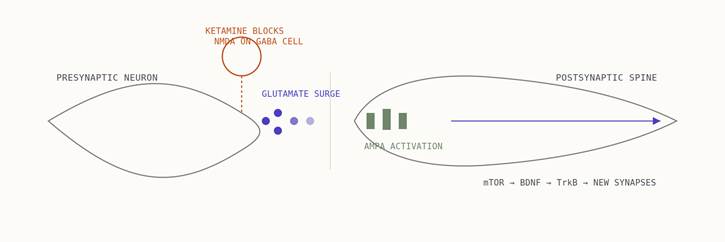
FIG. 1. Simplified schematic of ketamine’s action at the glutamatergic synapse.
For sixty years, antidepressant science has revolved around one idea: raise serotonin, and mood follows. Ketamine broke that model. A single low-dose infusion can lift severe, treatment-resistant depression within hours, not weeks, and the reason has nothing to do with serotonin at all. It has to do with glutamate, the brain’s most abundant excitatory neurotransmitter, and the discovery that depression may be, at its core, a disorder of broken synaptic connections rather than a simple chemical deficit.
Beyond Serotonin: The Glutamate Hypothesis of Depression
Selective serotonin reuptake inhibitors (SSRIs) target the monoamine systems, serotonin, norepinephrine, and dopamine, and typically take four to six weeks to produce a meaningful response, if they work at all. For roughly a third of people with major depressive disorder, they never do.
The 2000 discovery that a single sub-anesthetic dose of ketamine could relieve depressive symptoms within hours redirected research toward glutamate signaling. Genetic studies have since linked several glutamate-receptor genes to depression risk and to the pathways that govern synaptic plasticity, lending weight to what researchers now call the glutamatergic neuroplasticity hypothesis: chronic stress and inflammation degrade glutamatergic signaling and weaken synaptic connections in mood-regulating circuits, and restoring that signaling quickly and robustly is what produces rapid symptom relief.
How Ketamine Blocks NMDA Receptors in the Brain
Ketamine is best known as a non-competitive antagonist of the NMDA receptor, one of the two major receptor types that respond to glutamate. But its antidepressant mechanism is more indirect and, in some ways, more elegant than simply “blocking” a receptor.
NMDA Receptor Antagonism and the Glutamate Surge
At low, sub-anesthetic doses, ketamine preferentially blocks NMDA receptors sitting on inhibitory GABA-releasing interneurons, the brain’s built-in brake pedal for glutamate signaling. With those interneurons quieted, the brake is released. Glutamate-releasing pyramidal neurons fire more freely, flooding the synapse with glutamate. Researchers have also described a related pathway in which ketamine’s inhibition of NMDA receptors reduces activity in HCN1 channels, further amplifying glutamate release from presynaptic terminals.
That surge of glutamate then activates AMPA receptors on the receiving neuron, a second class of glutamate receptor that ketamine does not block. It’s this AMPA activation, arriving in a sudden burst rather than a slow trickle, that appears to trigger the cascade responsible for ketamine’s antidepressant effect.
Ketamine, BDNF, and the Neuroplasticity Cascade
AMPA receptor activation sets off an intracellular chain reaction inside the receiving neuron. It engages the mechanistic target of rapamycin (mTOR) pathway, which governs protein synthesis needed to physically build new synaptic connections. In parallel, levels of brain-derived neurotrophic factor (BDNF) rise, activating TrkB receptors that stabilize and strengthen those emerging connections.
mTOR Activation and New Synapse Formation
● mTOR activation switches on the cellular machinery for building new dendritic spines, the tiny protrusions where synapses form.
● BDNF release acts as a growth signal, supporting neuron survival and guiding synaptic strengthening.
● AMPA receptor upregulation increases the receiving neuron’s sensitivity to future glutamate signals, reinforcing the new connection.
● Reduced neuroinflammation: ketamine has also been shown to lower inflammatory markers that are elevated in chronic depression and that interfere with plasticity.
The net effect, observed in animal studies within hours of a single dose, is measurable synaptogenesis, the formation of new dendritic spines, concentrated in brain regions like the prefrontal cortex and hippocampus that are consistently smaller and less active in people with chronic depression.
Ketamine’s Effect on the Hippocampus and Prefrontal Cortex
Two structures show up again and again in ketamine research: the hippocampus, central to memory and stress regulation, and the anterior cingulate cortex and prefrontal cortex, which govern emotional regulation and executive function. Chronic stress shrinks dendritic branching in both. Ketamine appears to reverse this: a single injection has been shown to selectively promote neurogenesis in the hippocampus in animal models, alongside changes in AMPA receptor expression tied to improved plasticity.
Neuroimaging studies point to a broader effect as well: shifts in connectivity across large-scale brain networks involved in emotional regulation, including the default mode network (associated with rumination and self-referential thought), the salience network, and the central executive network, all of which tend to be disrupted in depression.
Why Ketamine Works Faster Than SSRIs for Depression
The clinical significance of this mechanism is hard to overstate. Traditional antidepressants adjust neurotransmitter levels gradually, and the downstream plasticity changes that actually relieve depression take weeks to accumulate. Ketamine achieves a comparable, sometimes more robust, plasticity effect within hours, because it triggers the glutamate surge and downstream cascade directly and immediately.
That speed has made it a genuine option for people in acute crisis, including those with treatment-resistant depression and active suicidal ideation, where waiting six weeks for an SSRI to take effect is not a realistic option.
Ketamine Therapy and Esketamine (Spravato) for Treatment-Resistant Depression
This research has already reshaped clinical practice. Esketamine (marketed as Spravato), the S-enantiomer of ketamine, is FDA-approved as a nasal spray for treatment-resistant depression, used alongside an oral antidepressant and administered under medical supervision. Intravenous and intramuscular ketamine, while not itself FDA-approved for depression, is widely used off-label in supervised clinical settings and has an extensive evidence base behind it for treatment-resistant and acute presentations.
IV Ketamine Therapy vs. Esketamine (Spravato) Nasal Spray
Because the antidepressant effect of a single dose is often temporary (typically lasting days to a couple of weeks), most protocols involve an initial series of sessions followed by spaced maintenance dosing, frequently paired with therapy to help consolidate the psychological gains that come with renewed synaptic flexibility.
How Ketamine Rewires the Depressed Brain
Ketamine’s antidepressant effect reframed how researchers think about depression itself: less a deficit of a single chemical, more a breakdown in the brain’s capacity to form and maintain synaptic connections under chronic stress. By briefly disinhibiting glutamate release, ketamine triggers a fast, self-reinforcing cascade (AMPA activation, mTOR signaling, BDNF release, new dendritic spines) that rebuilds those connections in the very circuits depression tends to erode. It’s a mechanism measured in hours, not weeks, and it has opened an entirely new class of fast-acting treatments now being studied for depression, PTSD, and beyond.
Medical and Educational Purpose
Content on KetamineTherapyWellness.com is intended for educational purposes only and is not a substitute for professional medical care. Nothing on this site should be construed as medical advice. Visitors should consult a licensed healthcare professional for medical concerns. Communications via this site do not establish a doctor–patient relationship. The site does not endorse or recommend specific treatments, providers, products, procedures, tests, physicians, hospitals, or opinions cited or linked.
